Pool Fence Legislation Queensland
Prior to new pool fence legislation being introduced to Queensland in December 2010, drowning in the backyard swimming pool was the leading cause of accidental death for children aged 0 to 4 years of age. This is why these laws were introduced, including the industry of Pool Safety Inspectors.
Everything Queensland pool owners need to know about the pool safety laws, including the Legislation and Pool Safety Standard for fencing, gates, latches, hinges, doors, windows and CPR signage requirements, explained in full.
Pool Fence Legislation Queensland and Child Drownings
Prior to new pool fence legislation being introduced to Queensland in December 2010, drowning in the backyard swimming pool was the leading cause of accidental death for children aged 0 to 4 years of age.
Royal Life Saving Society releases a National Drowning Report each year. In the Report for 2025 it was identified that 10% of all drowning deaths occurred in swimming pools, with 35 drowning deaths occurring in 2024/2025. That is a 6% increase on the 10 year average.
Drowning deaths continue to be a high area of concern for children aged 0 to 4 years, with 73% of all drowning deaths occurring in the private home. The leading activity prior to drowning was swimming and recreating (54%) followed by an unintentional fall into water (29%). Summer was the highest month for drowning deaths, with 60% occurring during those warmer months.
Successful decreases in drowning numbers and rates in this age group have occurred over the years due to increased public awareness and education, advocacy and research, government policy and enforcement. This age group still remains a priority area in the Australian Water Strategy 2030, as rates of childhood drowning deaths remain high relative to other age groups. Changes to pool safety legislation and the introduction of a new pool safety standard to Queensland has contributed to these decreases.
Background to Pool Fence Legislation Queensland
Swimming pools should be fun, however prior to new pool fence legislation being introduced to Queensland, drowning in the backyard swimming pool was the leading cause of accidental death for children aged 0 to 4 years.
On the 14th of December 2008, the Premier announced the most comprehensive review of pool fence legislation Queensland had seen in nearly 20 years. An expert committee was established and made 23 recommendations aimed at reducing drowning and serious immersion injuries suffered by young children. In September 2009, the Government announced the implementation of a two staged swimming pool safety management strategy.
The Building Act 1975 and Building Regulation 2021 includes Chapter 8, which relates to swimming pool safety. Amendments were made to this legislation to improve pool safety, and a new licensed industry of pool safety inspectors was established, including an inspections regime with pool fencing certification aimed at ensuring that pool barriers around swimming pools were safe and compliant.
The first stage commenced in December 2009 and introduced a new pool safety standard to Queensland for pool barriers. A pool barrier installed around a new swimming pool was required to comply with this new pool safety standard, which includes the QDC MP 3.4, with the Australian Standard 1926.1-2007 and 1926.2-2007.
The second stage commenced in December 2010, broadening its scope to also include all existing swimming pools and pool barriers. Pool owners were now required to register their regulated swimming pool on the Swimming Pools Register and obtain a pool safety certificate from a licensed pool safety inspector prior to the sale or lease of the property. A pool safety certificate confirms that the pool barrier complies with the pool safety standard.
What Is the Pool Safety Standard?
The pool safety standard is designed to minimise the chance that young children can get into the pool area unsupervised. Pool owners are required to ensure their pool is fenced and meets the pool safety standard.
- The required height and strength of fences
- Non-climbable zones
- Gates and their self-closing and self-latching requirements
- How to prevent direct access from a building into the pool area (doors, windows)
- Mandatory CPR signage
Pool fencing legislation Queensland laws refer to pool barriers, which include gates. We use the term pool fence, and this can be made of a range of components that restrict access to the pool, including fences, posts and panels, gate units, gates and door sets, built or natural walls (including retaining walls), sides of buildings, and balustrades of a balcony.
Fences Must Be
- At least 1200mm high (measured from finished ground level to the top of the fence)
- Less than 100mm from the ground at the bottom
- Built on stable and solid ground
- On sloping or stepped sites, a minimum of 1200mm high at any location
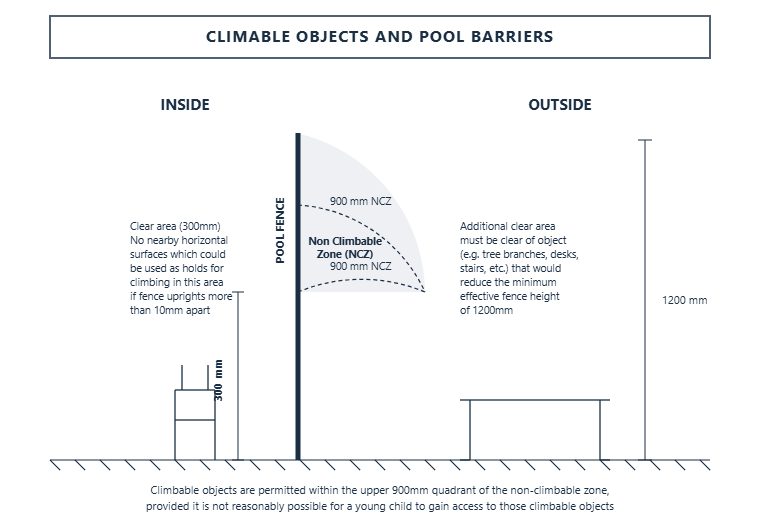
The pool safety standard requires fences to have continuous 900mm non-climbable zones, areas that cannot be climbed by a small child. The standard also requires pool owners to create a clear area on the inside of the pool fence immediately next to the external non-climbable zone, moving anything that would make the fence easy to climb 900mm away from the outside of the fence, and 300mm away from the inside.
What Is Required of a Pool Gate?
It’s important to always keep the gate shut. This will stop young children from accessing the pool unsupervised.
- Not open towards the pool
- Be self-closing
- Self-latch from any open position
Pool gate hinges can be climbed by children if they jut out more than 10mm, so extra rules apply. They must be at least 900mm apart from the top of the lower hinge to the top of the top hinge, or have a 60-degree safety cap added to the lower hinge if they are closer than 900mm apart. Safety caps can be bought from a hardware store.
Outside and Inside Latch Requirements
Pool gate latches on the outside must be at least 1500mm from the ground (measured from the finished ground level to the underside of the latch-release handle), and 1400mm above the top of the highest lower horizontal member.
Pool gate latches on the inside must be at least 150mm below the top of the gate (or any hand-hole), and covered with a 450mm-radius shield, with no gaps greater than 10mm within this shield when the gate is closed, to help stop children from putting their fingers into the gap to release the latch.
What Is Required of Doors and Windows?
Make sure no doors open directly onto your outdoor pool or spa area.
Only indoor pools or spas may be accessed by a child-resistant door set. A child-resistant door set cannot be used to access outdoor pools. For a child-resistant door set: the door handle must be at least 1500mm high, the door must not open towards the pool, the door must be self-closing and self-latching, and there must be no climbable items within the non-climbable zone
A window can be part of your pool or spa fence if it has a clear drop of at least 1800mm from the sill down to the pool area, and the sill is not less than 1200mm high on the inside with no climbable objects within 900mm (non-climbable zone). If the bottom of your window is between 900mm and 1200mm from the floor on the inside, you can use a permanent flyscreen (a fixed security flyscreen).
If your window opens onto the pool or spa area and does not fit these requirements, you need to make sure it cannot open more than 100mm, either by fitting a permanent security screen, or by altering the window so it cannot be opened more than 100mm by permanently fixing screws or similar to the top and/or bottom of the openable section of the window.
What Is Required of a CPR Sign?
The pool safety standard also covers pool safety signs. You must display a compliant CPR (cardiopulmonary resuscitation) sign, attached to the pool fence or barrier, or somewhere near the pool so it is conspicuous and anyone near the pool can see it.
- Show how to perform CPR
- Be attached to the pool safety fence, or displayed near the poo
- Be easily visible to a person near the pool
- Be at least 300mm by 300mm
- Be made of durable and weatherproof material
- Include a prominent statement explaining how to act in an emergency (e.g. call 000, stay with the injured person, provide first aid)
- Comply with Guideline 8 of the Australian Resuscitation Council guidelines, including DRSABCD and the compression to ventilation ratio of 30 compressions to 2 breaths
Why Train With APSIC
Now you have a better understanding of the pool safety laws and what’s required of a pool barrier. Completing the 11067NAT course via live face-to-face zoom webinar over 2.5 days, turns that knowledge into a QBCC Pool Safety Inspectors licence.
Jacqui teaches in real time via live face-to-face via zoom webinar, over 2.5 days. Ask questions as they come up, interact with fellow students, and stay on track with an industry-experienced trainer, with 15+ years experience.
Complete all written assessment during the course ready to submit for marking at the conclusion. A 90% pass mark required. Only the practical video remains after (short 15 min inspecting compliant and non compliant barrier), making your QBCC application the fastest possible next step.
Every APSIC student gets three free onsite inspection queries after receiving their Pool Safety Inspectors licence. Jacqui will be there to support you after your training, when you carry out your first inspections.
Jacqui will support you to set yourself up for business success. Templates such as Pool Safety Inspection checklists, Booking sheets, Nonconformity Report templates, and QDC MP 3.4 diagrams, will support you in getting yourself business ready, and to start taking clients immediately after you’re licensed.
For further information regarding pool safety laws and pool safety certificate QLD legislation, please visit the QBCC website: qbcc.qld.gov.au/your-property/swimming-pools/pool-safety-standard
Ready to become a licensed Pool Safety Inspector?
Turn your understanding of this legislation into a QBCC licence. Enrol in APSIC’s 11067NAT course, live via face-to-face Zoom webinar over 2.5 days with Jacqui Murphy.
Enrol now — early bird $1,390 →